Showing posts sorted by relevance for query australian light horse. Sort by date Show all posts

Friday, 15 August 2014

With the RGH to Suvla and a meeting with Billy Sing.

We were back again at the National Archive last week. Again, once the official business was over I ordered up the Regimental War Diaries of some of the Yeomanry Regiments that went out to Gallipoli in August 1915. They landed at Suvla  as part of  the now dismounted Mounted Division and were withdrawn at the end of October.

Officers of the 2nd Mounted Division receive orders and briefing before the night attacks on Chocolate and Scimitar Hills 21 August, 1915.

I was particularly taken with the diary of the Royal Gloucestershire Hussars. Written by the Adjutant, Lt. Michael Hugh Hicks-Beach, Viscount Quenigton, initially on pages torn from his notebook and only later on the official sheets. He signs himself simply as "Quenington".

Lieutenant, later Captain "Quenington" survived Suvla and continued as Adjutant until his death at the disaster at Quatia, 23 April 1916. More on this in a future post. 

Captain, the Honourable Michael Hugh Hicks-Beach, Viscount Quenington, 
Adjutant Royal Gloucestershire Hussars.


Here's the official  RGH account of their time in Gallipoli (WO 95/4293):


I also rummaged through the diary of the Middlesex Hussars for the same time period. I was pulled up short by this page where Captain Subbins charts the effects of disease.

I was also very pleased to discover that the diaries of the Australian Light Horse Regiments 1915-18 are at the National Archive. Some are photograpgic reproductions (the originals now at the Australian War Memorial, I believe) but a few original pages are mixed in there as well. I called up the Gallipoli diary of 5th Australian Light Horse. This diary was a photographic reproduction done quite some time ago and it did not photgraph well, there being very little contrast between the writing and the background so no images I'm afraid. However, the tone of this Aussie diary is very different to those of British Regiments. Ordinary Troopers are named throughout when they are wounded, sick or do something worthy of note. The naming of "ORs" in British diaries is relatively rare.

I read, with interest, a reference in the diary to Trooper Billy Sing, a Chinese-Australian and legendary sniper known as "The Assassin". The diary entry celebrates Sing's accuracy as he had just increased his tally to over 150 confirmed hits. The entry describes Sing's "modus operandi" (the diary's phrase, not mine). His spotter, armed with a telescope, would train it on a "loophole" in the Turkish sand-bag parapet or any other target that presented itself. Sing would cover the spot with his rifle at ranges between 400 to 1000 yards. When the spotter saw movement he would simply tell Sing to shoot. Sing would oblige and the spotter would record the result. Sing went on to claim 201 kills and earn himself the Distinguished Conduct Medal. Have a read about Billy Sing here. Here he is:


Monday, 29 March 2010

Woodbine Australian Light Horse 1


Mix-n-match heads from Woodbine Designs. This time, 10th Australian Light Horse fighting as infantry at Suvla, 1915.

Thursday, 16 November 2017

4th Australian Light Horse 1.

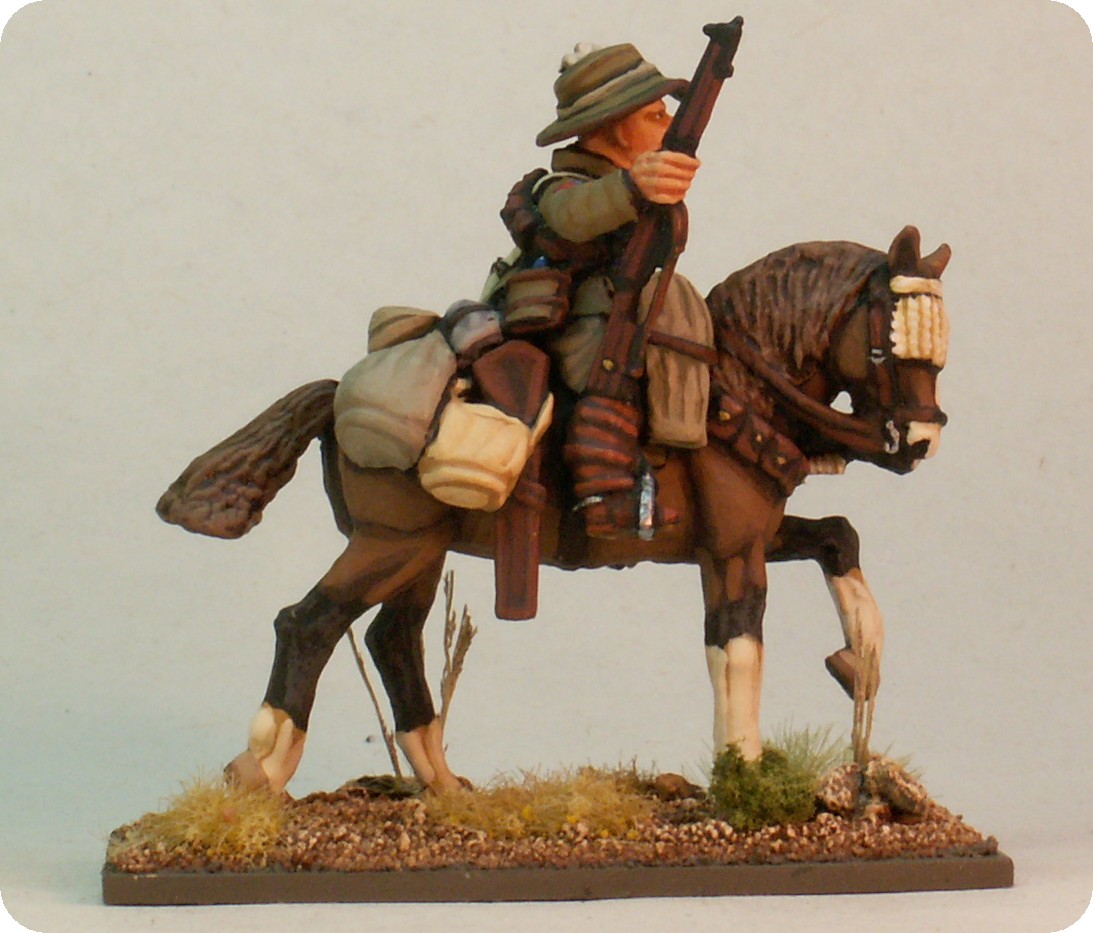
These figures are from Blaze Away available from Lancashire Games. Painted up as the 4th Australian Light Horse (tiny detail of the the patch in the sleeve) with some added clutter and an extra blanket to the saddle. Half way through the unit of ten mounted and ten dismounted. The keen eyed among you will notice that, through the miracle of "Instant Mold" and green stuff, I have added swords to these Lighthorsemen. They were issued swords in 1918 and these chaps will be used for a game set during "The Great Ride"of that year through northern Palestine and Syria. Another post showing all complete will follow in due course.


Friday, 1 September 2017

Australian Light Horse Test Pieces.

Sometime soon a couple of units, both mounted and dismounted, of Australian Light Horse will be on the panting table. But what to do? There are not many figures out there that cover the ALH in Egypt and Palestine. I am not a fan of the ALH figures from Brigade Games and the only other option seemed to be conversions but the number of individual conversions required is somewhat off-putting. Then I remembered these chaps from Blaze Away (now owned by Lancashire Games). They are a little slender when compared to figures from Brigade Games, Great War Miniatures and Mutton Chop but I like them. The sculptor (and I would like to know who did these figures) has a created figures that ARE Lighthorsemen. The headgear is spot on. They wear an Aussie tunic. The LMG team carry a MK1 Hotchkiss. There is something about them that appeals to me.  So here are a few test pieces to see what they would look like painted up and based. What do you think?


P.S.

Since making the original posting a couple of days ago a few people have asked me about the size of these figures when compared to other manufacturers. Here is a brief comparison:
Dismounted: (from left to right) Mutton Chop, Great War Miniatures, Blaze Away, Footsore miniatures, Woodbine Designs.

Mounted: (from left to right) Mutton Chop, Footsore Miniatures, Blaze Away, Great War Miniatures


Saturday, 4 February 2012

Australian Light Horse. Great War Miniatures Conversions. 3.

Finally! I've had to struggle to get time to paint up the first two conversions over the last week, but here they are. Both wear the patch of the 5th Australian Light Horse. Eight more to do. The blog will now go quiet for a while.....


Wednesday, 25 January 2012

Australian Light Horse. Great War Miniatures Conversions. 1.

So, I am armed with ten GWM 1914 British Cavalry figures all carrying rifles and some heads wearing the slouch hat, not from Woodbine Designs as one may think, but sculpted by Dave Andrews and Aly Morrison of Great War Miniatures. These heads will have to be removed from cast metal foot figures that the GWM chaps have obviously had cast for their own collections as such things are not on sale. These slouch hat heads will replace the heads wearing SD cap on the original figures. That, I think, will be the easy part.

I want to add bits. The greenstuff is willing even if my skill is not great. A look at some period images will show that the ALH in Palestine loaded a lot of kit onto their Waler horses. These horses were refered to as "ponies" by some, but they were an hardy Australian breed of horse.

Not what you might expect. This trooper on a donkey (I think he may be a signaler as there appears to be two flags on the saddle) looks to be wearing the Small Box Respirator bag. I'd be interested to hear if anyone who reads this can either varify or deny this. Also note the all important bayonet on the left. Will need to sculpt this on to the GWM cavalry.


Palestine 1918. In stables by the look of it. The trooper is wearing Puttees.... food for thought as my first thought was to try to sculpt the leather leggings with spiral straps on every figure. Perhaps now I have the option?

A lot of kit: canvas bucket, forage bag, what looks like a blanket rolled within a groundsheet on the front of the saddle, extra bandolier on the front of the saddlecloth and something I can't make out round the horse's neck... another bandolier? Also, the ALH kept the manes and tails of their horses long. The GWM British cavalry have cropped manes and shorter tails. Some greenstuff there as well, I think.
Now this is the look I'm after. Cpl Austin Edwards with his mount Taffy, who stood patiently over a wounded Cpl Edwards as he pulled himself up off the ground and back into the saddle at the Battle of Romani, 1916. Look at all that kit including the rifle bucket. Taffy has an extra bandolier round his neck and a water bucket.

ALH at halt 1917. Webbing rifle slings seen here. Other photos show leather.... will paint both. Ah, that odd bag again on the trooper in the foreground.... well, like an SBR bag it has the press studs on the flap and the rings through which string was tied to tie around the back (and chest) when worn on the front of the chest. But does it contain a gas mask? Lots of leather leggings and few hats with the sides pinned up. Some with pugaree on slouch hat, others with a plain khaki band. Emu feathers in evidence. Lots of kit on the mounts too. Great photo for inspiration.


Two of the last casualties of the 1st ALH in 1918, their mounts looking on in a staged but moving image. Both mounts sport fetching (locally made?) headgear to keep the flies out of their eyes. Will have to have one or two with this.


SHORTS! I'm afraid not... But Puttees again (or just socks?). I like the way the canvas bucket is stowed. Small billy can too and similar at the front of the saddle.


Ah... Puttees and leather leggings in the same image. Good. I will have both. Officer in peaked cap. This is good news as I have ten figures to convert and only nine heads! The Officer will retain his Soft Cap.


Long manes and tails, again.

And finally, to get in the mood, a clip from the 1940 film "Forty Thousand Horsemen". The ALH Brigade has a set too with Johnny outside a little place called Beersheba, Palestine, in October 1917: http://aso.gov.au/titles/features/forty-thousand-horsemen/ Click on CLIP 3.

For those who might like similar, but in colour, then have a gander at a couple of clips from the 1987 film "The Light Horsemen.": http://www.youtube.com/watch?v=rqaXAFnDWt0 AND http://www.youtube.com/watch?v=3C2elnoe3Sg&feature=related


All that remains now is to start......... Nurse! The screens!

Monday, 2 February 2015

The League of Extraordinary Kriegspielers' "Assault Across Suez, 1915" Demonstration Game, Vapnartak 2015.

I wish I could have been there to see the League of Extraordinary Kreigspielers' "Suez 1915" demonstration game at Vapnartak, York, yesterday.

A couple of photos have been hastily developed and sent via carrier pigeon to Over Open Sights HQ.
The first shows a vast number of British Imperial mounted troops and artillery support en-route to reinforce the troops resisting the Ottoman raid. In the image you can see the Royal Gloucestershire Hussars, the South Nottinghamshire Hussars, Imperial Camel Corps, New Zealand Mounted Rifles, Australian Light Horse and the Deccan Horse. It came a quite a surprise to see units I have painted concentrated together. These figures reside in the collections of Steve "Ignatieff" Langan and Adrian "The Beast of Bukhara" Shepherd.

The second is a great photo of a Royal Naval Monitor (based on M33 at Portsmouth) built for the game by Cameron Thomson and turning her 6 inch guns on the encroaching Turks. She is beautiful. In the distance I think I can see Indian troops that were once on my painting table.


Darrell Hindley has posted a large number of photos of the game on his blog Just Add Water. Here are a few.
Ottoman Arabs on camels force the crossing.

By Jove!  A blast from the past... Copplestone Gurkha's done a while back.

Fantastic. Deccan Horse, Bikaner Camel Corps and Imperial Camel Corps. 
Three of my all time favourite projects. The RHA teams are a collaboration with "The Beast".

Latest pigeon brings in a couple more official photographs: