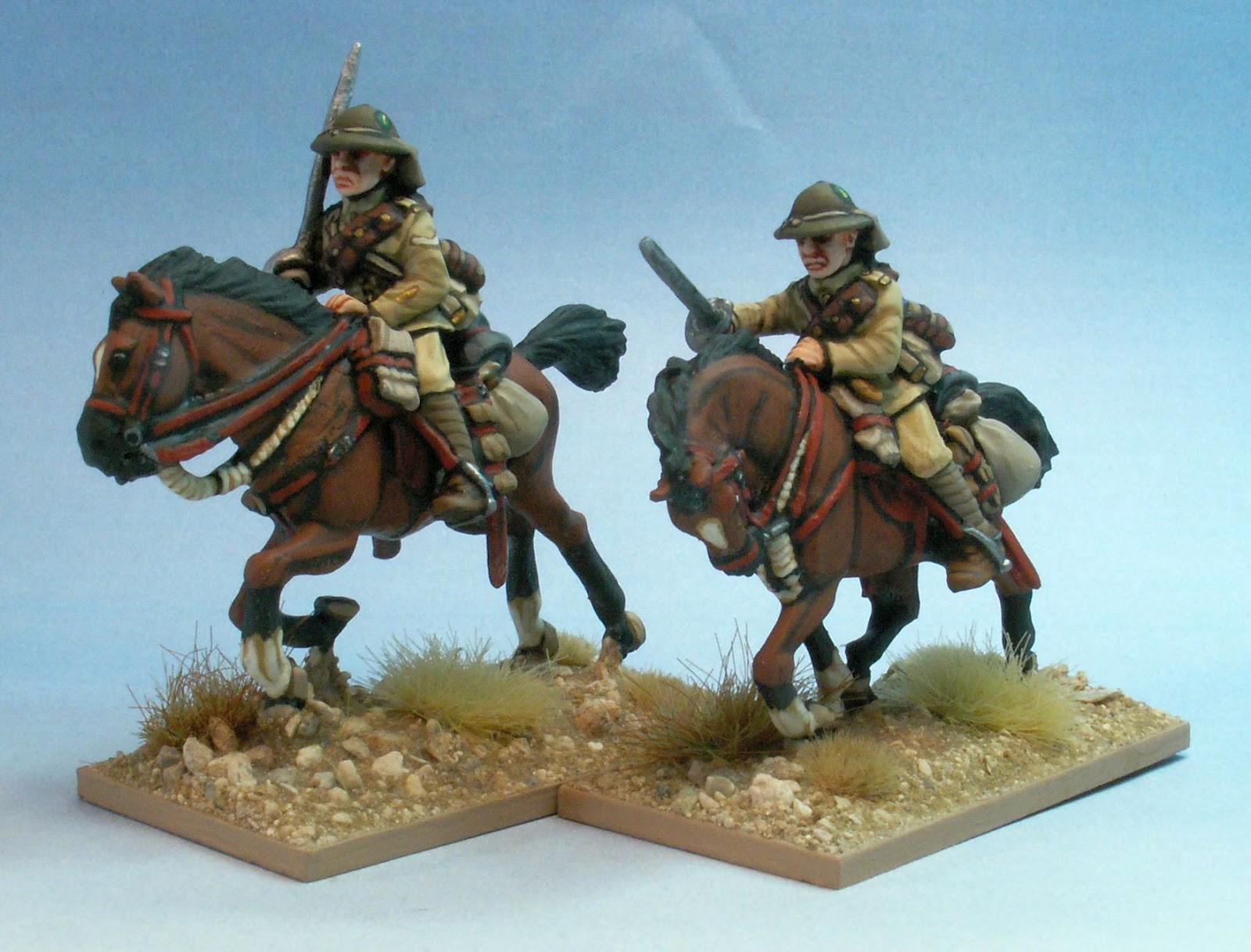
The Sherwood Rangers, Syria, 1918. A mix of six Mutton Chop British Cavalry, two Great War Miniatures early war British Cavalry Troopers and two Perry Miniatures WW2 British Yeomanry command types. All the troopers have been given Woodbine Designs head-swaps to try to get that very late war in the Middle East look. A mix of khaki drill and serge uniform here. A few painting short-cuts have been taken on some of these figures as the clock is ticking and there is still the dismounted Sherwood Rangers and a number of miscellaneous figures to do before the game at Colours.
Showing posts with label Mutton Chop Miniatures. Show all posts
Tuesday, 28 August 2018
Sunday, 20 May 2018
Tuesday, 10 April 2018
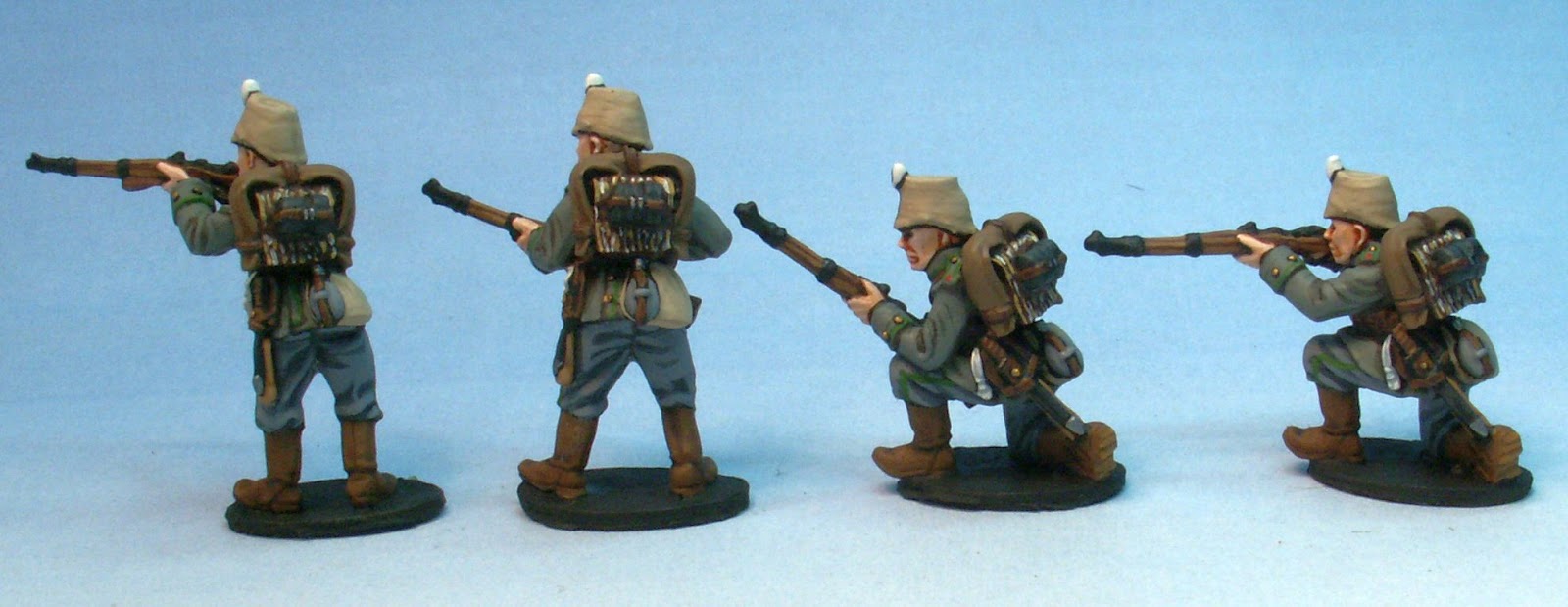
Mutton Chop WW1 German Jaeger. Pack GER11.
Part of a job of sixteen of these chaps. This is the first tme I have had the opportunity to paint up the two Jaeger packs from Mutton Chop in their normal uniform rather than that worn in Palestine. Pack GER12 is currently on the table. Basing to be done by the client.
Sunday, 5 November 2017
2/15 London Regiment (Civil Service Rifles), 179 Brigade, 1917-18.
I took some time to experiment with speeding up the painting process for my own collection of Tabletop Tommies given that I don't have a lot of time to devote to painting my own figures. I decided that I would cut cards with the Devil and have a go at a basecoat-wash-highlight technique. I have not done this before. Needless to say that this speed painting technique is NOT something I will be offering to my paying clients!
I had all the ingredients to make up my own ink washes (acrylic medium/inks/water/a drop of washing up liquid and some 10ml plastic dropper bottles). I mixed up three different shades and intensity of wash not really knowing what the end results would be like and tried all on these ten figures.
I think I found the right one by the end... a mix of six drops sepia ink and six drops umber ink in a 10ml bottle. Some washes are too subtle and do not pick out the detail enough, particularly on the front of the tunic.
I also tried both a black and a grey undercoat. Again, I think the two figures painted on a black undercoat are more successful.
These figures are a mix of Woodbines, Mutton Chop and a Footsore officer figure, all with Woodbine tin helmets with neck flaps. The Brodie helmet arrived in Palestine in the interval between the Second and Third Battles of Gaza when there was sustained period of trench warfare on the Gaza front.
This technique worked better with the Footsore and Mutton Chop figures. The Woodbines (the Lewis Gun team) are very "smooth" figures and in my opinion, do not take well to washes.
This was very much a steep learning curve and when I repeat this technique on the 2/13 London Regiment (Kensingtons) I think all will be black undercoated and washed with the sepia/umber mix.
Did it save time? Yes. I was able to "knock out" this unit of ten in half the time it would normally take to paint in my normal style.
Would I use it for everything? No. The bulk of the infantry would look acceptable from a distance but I don't think they bear up to close scrutiny. Command figures and other specials will always get my normal painting method.
So, these are, I think, the two most successful of these experimental ten. The figure on the left is black undercoated. The figure on the right is grey undercoated. Both have the darker sepia/umber mix wash.
The blue patch is correct thanks to some interweb trawling and the excellent pool of collective knowledge that is the Great War Forum. 179 Brigade adopted a system of circular patches during their short time on the western front prior to being dispatched to Macedonia in June 1916. They brought this scheme with them to Palestine in the early summer of 1917:
2/13 Kensingtons - green
2/14 London Scottish - yellow
2/15 Civil Service Rifles - blue
2/16 Queen's Own Westminster Rifles - red.
2/14 London Scottish are almost complete. I relised that I lacked a kilted Lewis Gun team. An order to Empress Miniatures is in the offing.
Monday, 23 October 2017
Sherwood Rangers Yeomanry, 1918.
Out of the blue, the chaps from "Wargames Illustrated" asked if they could use some of my images of WW1 Yeomanry troopers for an forthcoming article on the Battle of Megiddo. With the caveat that the Yeomanry I have painted cover 1915-17 I offered to do a quick headswap to give a couple of troopers a Brodie helmet for that "1918 look" when the steel helmet became much more in evidence in Palestine. So here are a couple of Mutton Chop Cavalry troopers with Woodbine helmeted heads painted up to represent the Sherwood Rangers Yeomanry, 1918.
The helmet patch of 1/1 Sherwood Rangers Yeomanry.
Sunday, 13 August 2017
163 Brigade Staff, Gaza, 1917.
Brigadier General T Ward, Officer Commanding 163 Brigade, watches on with his Brigade Major as the two Mark I tanks in support of his brigade slowly rumble forward towards the Turkish positions that would later become known as Tank Redoubt following the Second Battle of Gaza. The tanks attracted the fire of every Turkish gun in the sector. Well sited Turkish machine gun positions took a heavy toll on his Brigade with the 1/4 and 1/5 Norfolks taking 75% casualties. The supporting battalion, 1/8 Hampshires could do little to help particularly as the artillery fire on the two tanks caused the Hampshires difficulty and heavy casualties among their ranks. 1/5 Suffolks in reserve could only watch on as the attack was abandoned once HMLS Nutty was hit and destroyed as it reached the Turkish trenches. Brigadier Ward as not impressed with the Tank as a new weapon.
Figures by Woodbine Designs, Mutton Chop and Footsore Miniatures. All have had their original heads replaced with Woodbine heads wearing Wolseley helmets. All have a little greenstuff added to create brassards.
Sunday, 30 July 2017
1/4 Norfolk Regiment (TF) and 163 Machine Gun Company 1917
Here are the four outstanding figures needed to complete the 1/4 Norfolks (TF). Three Woodbines and a Footsore Miniatures figure.
A picture of the completed unit.
As part of the project to build 163 Brigade for the Second Battle of Gaza, we need to have the Brigade's Machine Gun Company. Here is 163 Machine Gun Company..
A couple of weeks ago I was able to read 163 M G Coy's War Diary at the National Archives. A great deal of information can be gleaned from this document starting with the formation of the Company in April 1916 with the amalgamation of the eight brass jacketed Vickers-Maxims from 1/8 Hampshires, 1/4 Norfolks, 1/5 Norfolks and 1/5 Suffolks and their problems in attempting to increase the number of guns in the company to sixteen. Personnel were a problem too. It seems that right up until the Third Battle of Gaza in November 1917, the ranks were filled by very few new men of the Machine Gun Corps being brought in from the UK. The diary indicates that many men were "on attachment" from the battalions of 163 Brigade with groups of men being rotated in and out of the MG Company. Hence these figures all wear different patches on their helmets and a purely conjectural yellow patch on the sleeve to denote being attached to 163 M. G. Coy.
The title page for the month of October 1916 before the Company became a company of 54 Battalion Machine Gun Corps in April 1918.
So here we have the Company CO, Captain Taylor and his CSM with a scratchbuilt rangefinder....
... and the battery itself.
All these figures are either Mutton Chops or Footsore Miniatures all with Woodbine headswaps.
Here is a page from the diary that mentions the support given by eight of the Company's guns to a raid on "Beach Post" made by a group of 1/8 Hampshires on 14th October, 1917 a couple of weeks before Third Gaza. 16000 rounds of ammunition were fired in a "barrage" before the Hampshires attacked. By this time the Company was equipped with sixteen Vickers guns shipped in from the UK. The Diary of 1/8 Hampshires has a very detailed description of this raid.... but that is for another visit to the National Archives.
On October 27th, 1917, Captain Taylor writes thus:
Oct 27 GAZA FRONT 202696 Pte. Johnson P.C., 1/5th Suffolks attached, ammunition carrier, was wounded in the head by a premature burst of one of our own shells. His steel helmet was pierced but broke the force of the splinter and undoubtedly saved his life. This was the first parade on which the steel helemets had been worn.
That answers a question of mine.... when did steel helmets reach Palestine?
Tuesday, 25 July 2017
Final elements to the Asia Corps
First up, Brigade Games' Asia Corps Lewis Gun teams.
Next, a unit of ten Jaeger. Four battalions of Jaeger were assigned to the Asia Corps, three battalions of the 146th Jaeger Regiment and the 11th Reserve Jaeger Battalion. In reality, they probably looked just like the rest of the figures in this project being equipped with the sun helmet or soft visored cap. For variety these figures have retained their distinctive shako and badger skin backpack. Perhaps not historically accurate, but an interesting diversion. The Officer, bugler and kneeling NCO come from Great War Miniatures and the remaining seven figures are from Mutton Chop.
Thursday, 22 June 2017
1/4 Norfolk Regiment (TF) 1917 1
Here are the first six of ten figures that will form 1/4 Norfolk Regiment (TF) as part of 163 Brigade alongside the Isle of Wight Rifles. Like the Hampshires they are kitted out in smoke hoods ready for their assault on Tank Redoubt at the Second Battle of Gaza. These are six of the latest releases from Mutton Chop's WW1 range. Oddly titled as "BEF Trench Raiders 1916", Paul Hicks sculpted these chaps to represent Tommies at Loos, 1915.
These chaps are painted up in "Sports Jacket and Flannels", a mix of khaki drill tunic and khaki serge trousers. A real pleasure to paint.
Subscribe to:
Posts (Atom)